
By Mary Kay Clunies-Ross, Executive Director, Chronic Disease Coalition
More than three in four American adults live with a chronic disease, and more than half live with more than one. That's not a niche health issue, and it’s not the “fault” of the individuals.
When 75% of Americans have a problem, it’s not an individual problem for just one person or one family to solve— it’s a systems problem that affects all of us.
For Chronic Disease Month, the Chronic Disease Coalition commissioned Fulcrum Strategy Group to do a national survey of 1,000 people living with chronic disease. These big numbers back up what our Ambassadors tell us in small conversations: chronic disease costs patients and families in ways that go far beyond a doctor's office.
Why the chronic disease perspective is so important.
Chronic disease patients aren't a niche population with unusual needs — they're the majority of health care system users, seeing it more often, over longer stretches of time, and across more of its moving parts than anyone else.
That makes their experience the most accurate diagnostic we have for how the system actually functions. And as our country pours more and more money into healthcare (it’s about 20 percent of our GDP), it’s crucial to understand why.
According to the U.S. Centers for Disease Control and Prevention, “Ninety percent of the nation's $5.3 trillion in annual health care expenditures are for people with chronic and mental health conditions. Interventions to prevent and manage these diseases can have significant health and economic benefits.”
Here is what patients are experiencing:
The Emotional Cost
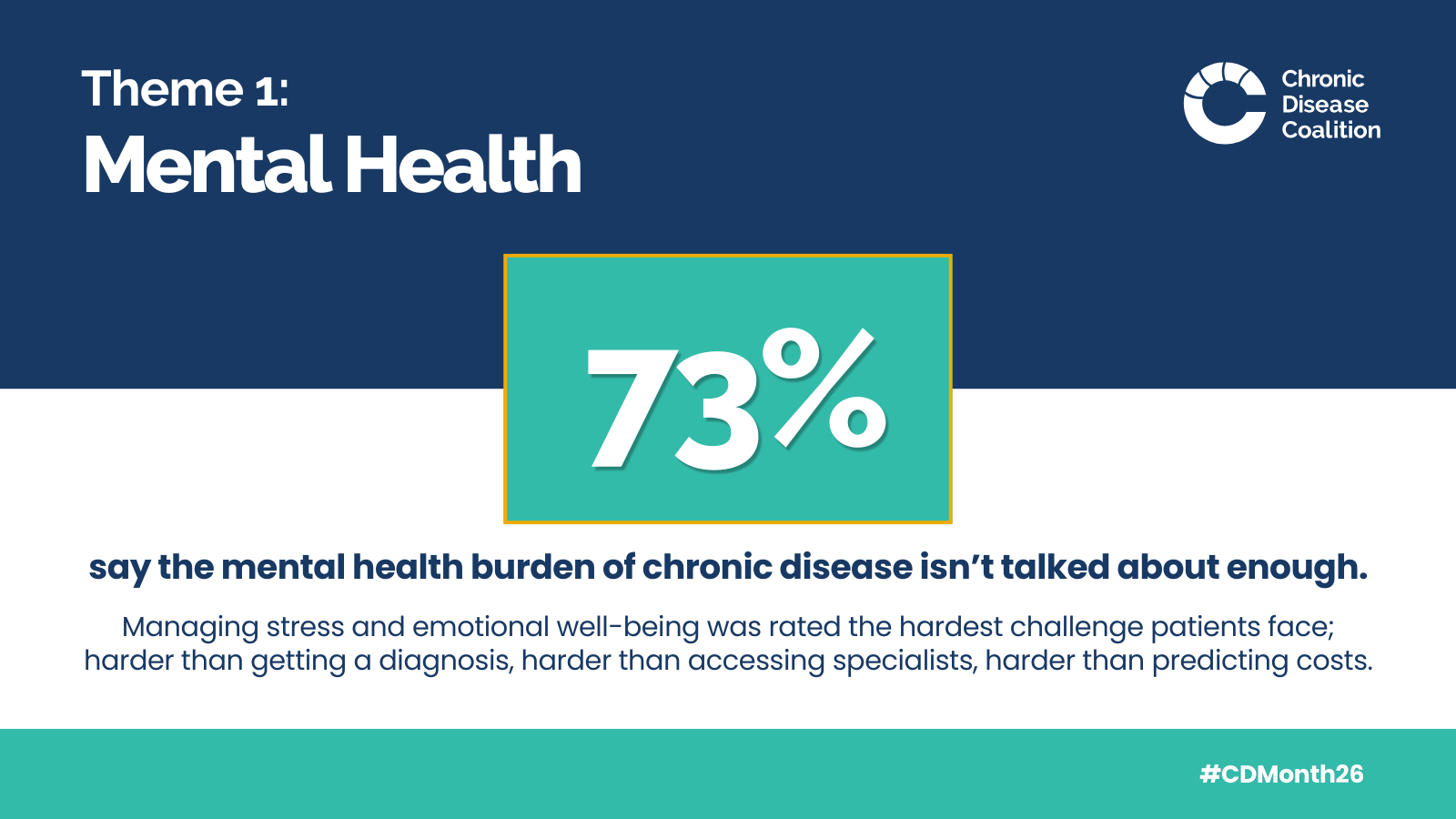
- Managing stress and mental health is the single hardest part of living with a chronic disease, harder than cost, harder than getting diagnosed, harder than anything else we asked about.
- 73% say the mental health impacts of chronic disease are not talked about enough.
- 40% say more mental health support, like counseling or a support group, would improve their physical health too.
- Patients feel least supported by their insurance company of any part of the healthcare system, and least supported by their employer of anyone in their life.
The reality is that every delay that occurs for a patient to receive the treatment, care, medication, or testing that they need comes at a cost to patients. That cost could be a delay in relief, a delay in their ability to get back to work and provide for themselves, care for their families. – Adam Lindo, Coalition Ambassador
The day-to-day choices that I have had to make have affected every aspect of my life - from not having children because it would be too risky, to remaining single due to a lot of relationship [implications],” says Gwen Mayes, Coalition Ambassador. “Even through a diagnosis might be unique, [chronic disease patients] often share feelings of anxiety, of disappointment, of not knowing who will believe them. A persistent feeling that no one understands them, they don’t have a place in society. They’re uncertain about their future, and this really weighs on them heavily.”
The Professional Cost
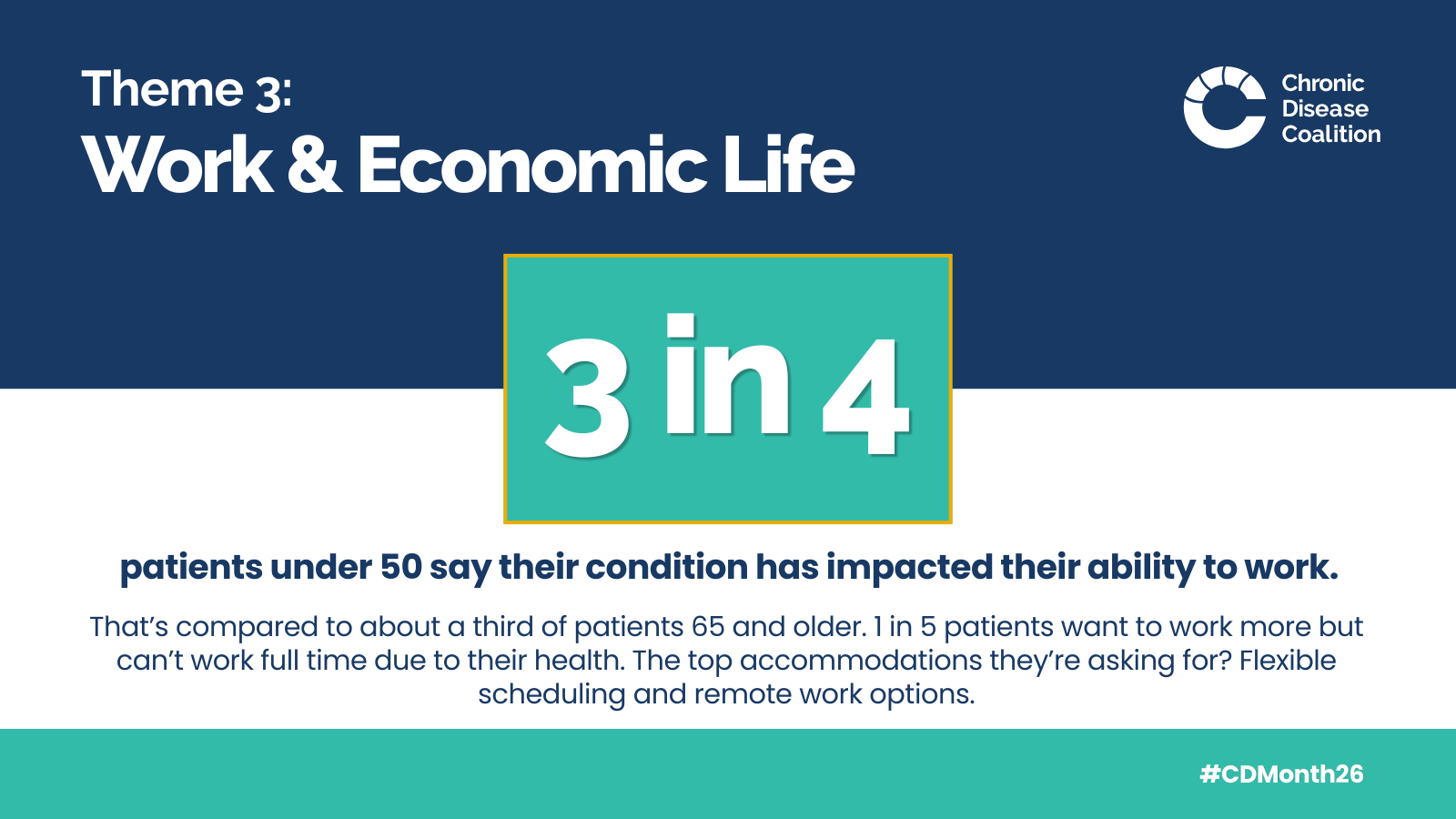
- 1 in 5 patients want to work more, but their health or a lack of workplace accommodation is holding them back.
- Nearly 3 in 4 patients under 50 say their condition has affected their ability to work, compared to about a third of patients 65 and older.
- Only 58% of patients have told their employer about their condition. Only 36% feel comfortable talking to their employer about it.
- What would help people stay in the workforce: workplace accommodations, flexible schedules, and remote work options.
The Financial Cost
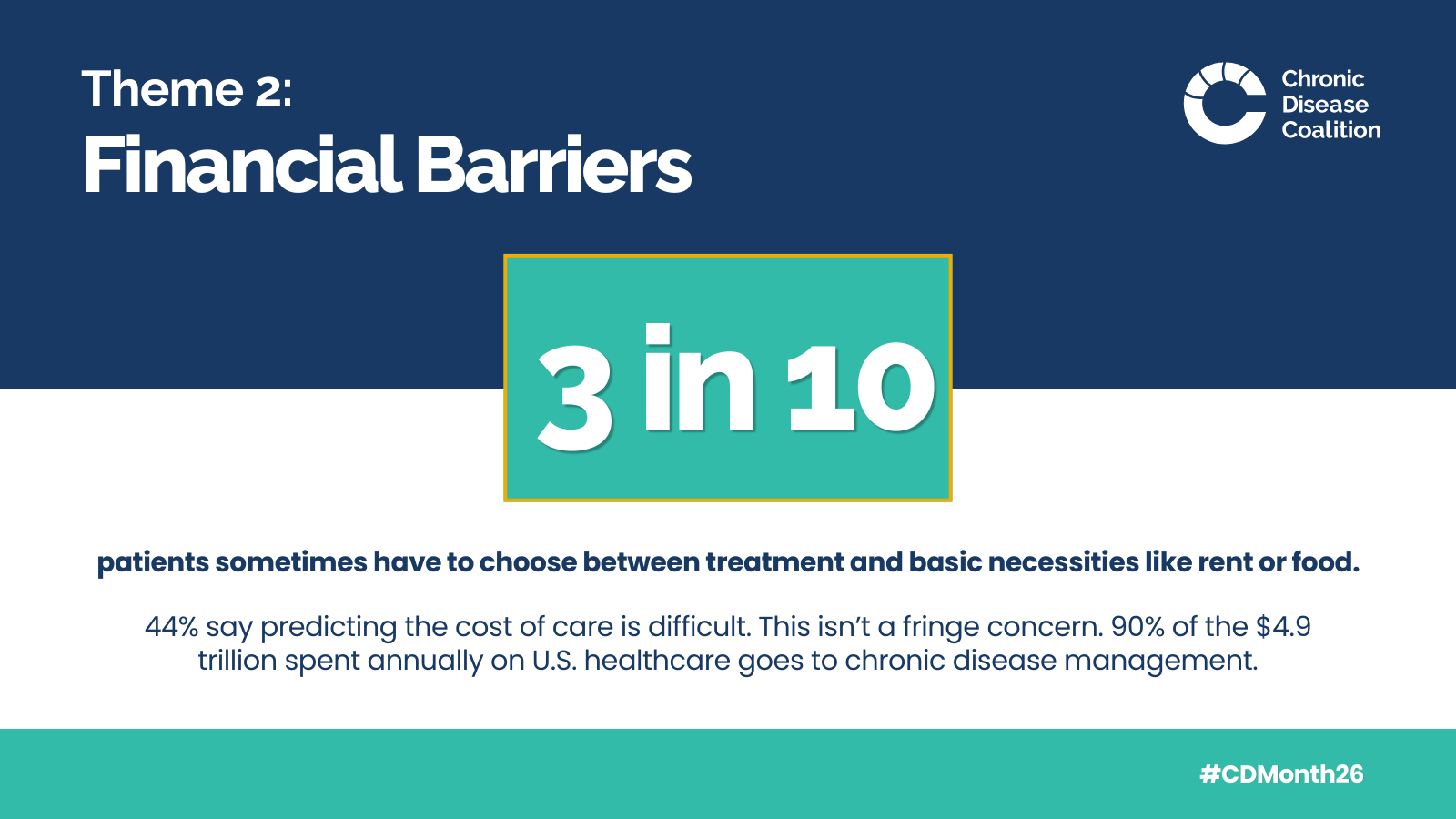
- Predicting the cost of care was the second-hardest part of living with a chronic disease.
- 36% of patients sometimes have to choose between medication or treatment and paying for other necessities.
- Uninsured patients face the steepest climb: 87% find it hard to predict costs, compared to 44% of insured patients.
- Patients' number one message to policymakers: make healthcare more affordable.
The purpose of my Multiple Sclerosis medications is to prevent new damage, so it doesn’t reverse course. If you're not taking the medications as indicated, you stand the risk of more damage, which means more symptoms that cannot be reversed, and symptoms that get added to your plate to continue to manage. – Anna Williams, Patient Advisory Council member and Coalition Ambassador
Younger Patients Face a Steeper Climb
- 73% of patients 18-34 say their condition has affected their ability to work.
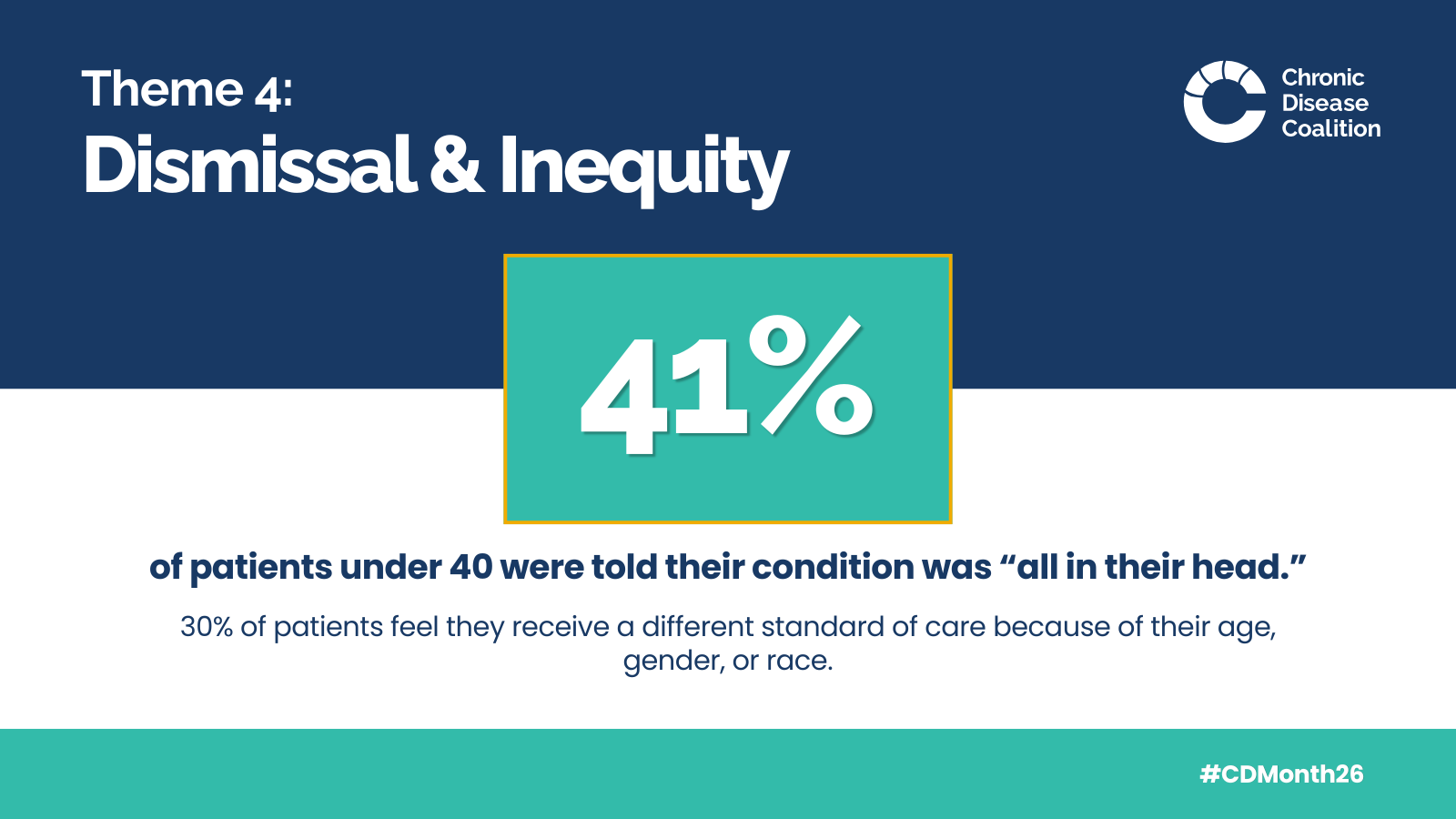
- 41% of patients 18-34 say a healthcare professional has told them their condition was "all in their head" or something similar, compared to just 3% of patients 65+.
- Younger patients are far more likely to struggle getting access to the right specialist.
My chronic illness has pretty much shaped every decision I've made about my future because it’s not just a medical reality, it’s a financial one, too. - Tori Lopez, Coalition Ambassador
Access to Care
Despite greater overall spending on healthcare, many communities are seeing their access to care being reduced.
- 20% of patients say they've been affected by closures or reduced services at their hospital, primary, or specialty care clinic over the last two years.
- Urban patients are more likely to report being affected (30%) than rural (25%) or suburban (23%) patients.
- 39% say getting access to the right specialist is difficult.
Representation means a lot because while [sickle cell] is considered a rare disease, it has the highest population [of patients with] inherited diseases in the country. So while it feels like [sickle cell patients] are a very small [group], there's quite a number of us. We can longer just be present. We have to be a voice. – Lathan Singleton, Coalition Ambassador
Political Ramifications: Shared Experience, Divided Conclusions
Patient sentiment tells a story with two very different halves.
The experience is bipartisan. Across nearly every question we asked, Republicans, Democrats, and Independents reported strikingly similar struggles with diagnosis, cost, and workplace strain. Chronic disease doesn't check a voter registration card.
The conclusions patients draw from that experience are not. When we asked about the federal government's handling of chronic disease specifically, the partisan gap opens wide:
- 41% of patients overall are more optimistic about the future because of the administration's focus on reducing chronic disease, but that ranges from 64% of Republicans down to 39% of independents and just 27% of Democrats.
- 32% overall say the federal government has done a better job addressing chronic disease over the last two years, ranging from 53% of Republicans to 21% of independents and 19% of Democrats.
In other words, patients broadly agree on the problem. They disagree on who's solving it, and how well.
Healthcare is a driving issue at the ballot box for nearly everyone.
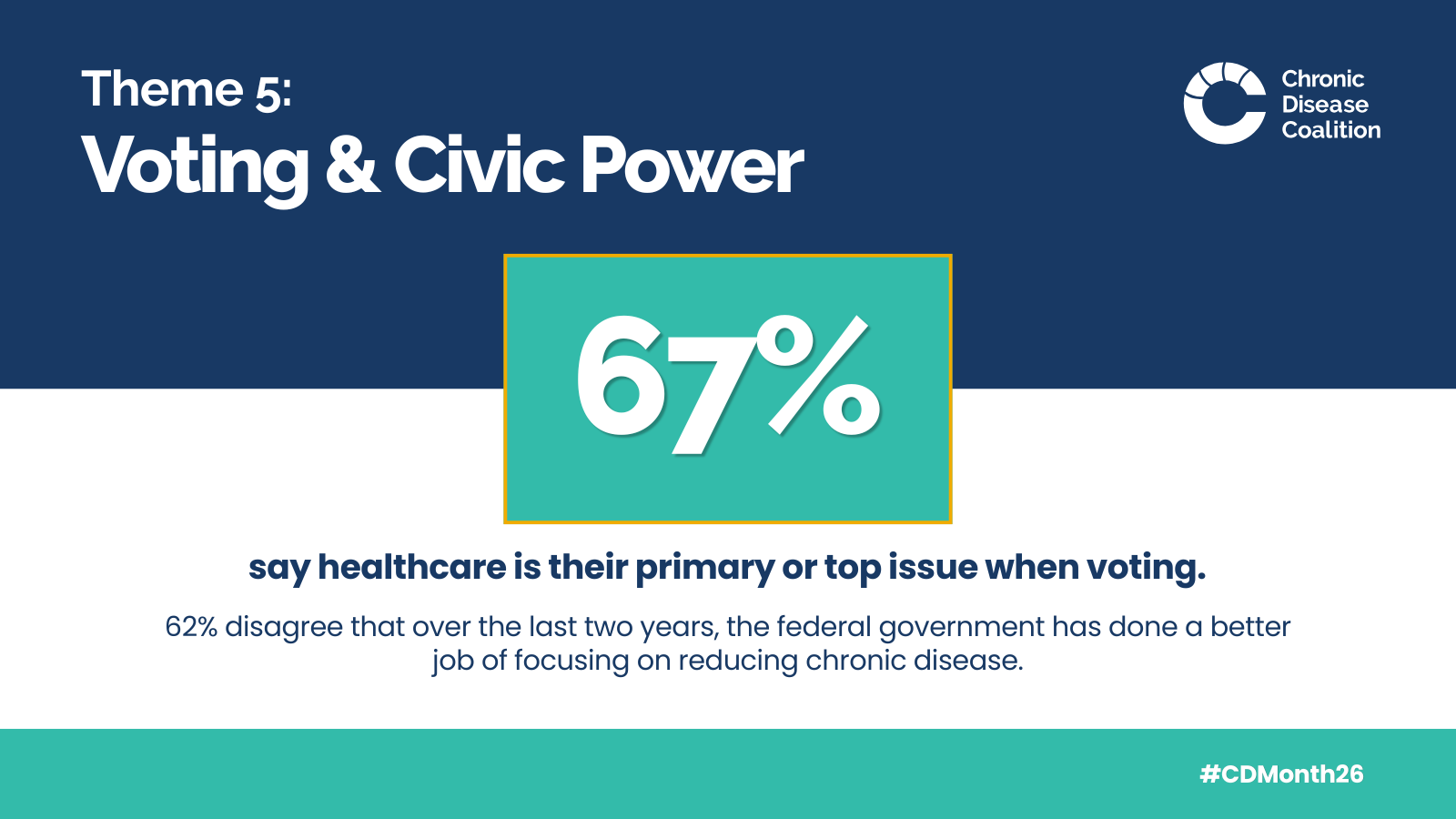
- 67% of patients say a candidate's position on healthcare and chronic disease is either the single most important issue (20%) or a top issue (47%) when they vote.
- That holds true across almost every subgroup we surveyed, but it's not evenly distributed. Patients of color, urban residents, Democrats, and patients under 50 are more likely to identify healthcare as their primary voting issue.
It’s no surprise that people have different attitudes when asked a direct question about the elected leaders of one particular party. The more important takeaway is that patients and families of all political perspectives are struggling with the same issues: accessible and affordable treatment. The Coalition’s focus will also continue to be there: the patient experience, regardless of party.
Where the Coalition stands. As a nonpartisan organization, we don't endorse candidates or parties, and we won't tell anyone how to vote.
What we do believe is that patients deserve to know where the people asking for their vote actually stand on the issues that shape their daily lives. That's why we built our voter guide, "Know Where Your Candidate Stands", a simple, nonpartisan way to check any candidate's record on chronic disease and healthcare before you head to the polls this November.
We will also celebrate our Legislative and Congressional Champions, starting July 15. These are the state and federal lawmakers who are engaging with patients, leading caucuses, and sponsoring legislation that makes the most difference to patients. (Subscribe to our newsletter or check the Chronic Disease Month page for details.)
Why This Matters
These aren't abstract statistics. With more than 194 million Americans living with a chronic disease, even small percentages add up to millions of people who are stressed, unsupported at work, and rationing care they need. That's not an individual patient problem. It's a healthcare system problem, and it calls for real policy solutions.
I would tell lawmakers that every policy decision you make, every vote on healthcare access, every debate about coverage, it really isn't abstract to [chronic disease patients]. I would implore them to remember that chronic illness doesn't check party lines or income brackets, and this could be your child, your grandchild, someone in your own family someday needing the exact system that you're deciding on right now. – Tori Lopez
For More Information
For more information about our survey, our policy priorities or our work, or to speak with one of our patient ambassadors, please contact Amy Steinmann, Communications Lead, Chronic Disease Coalition.