
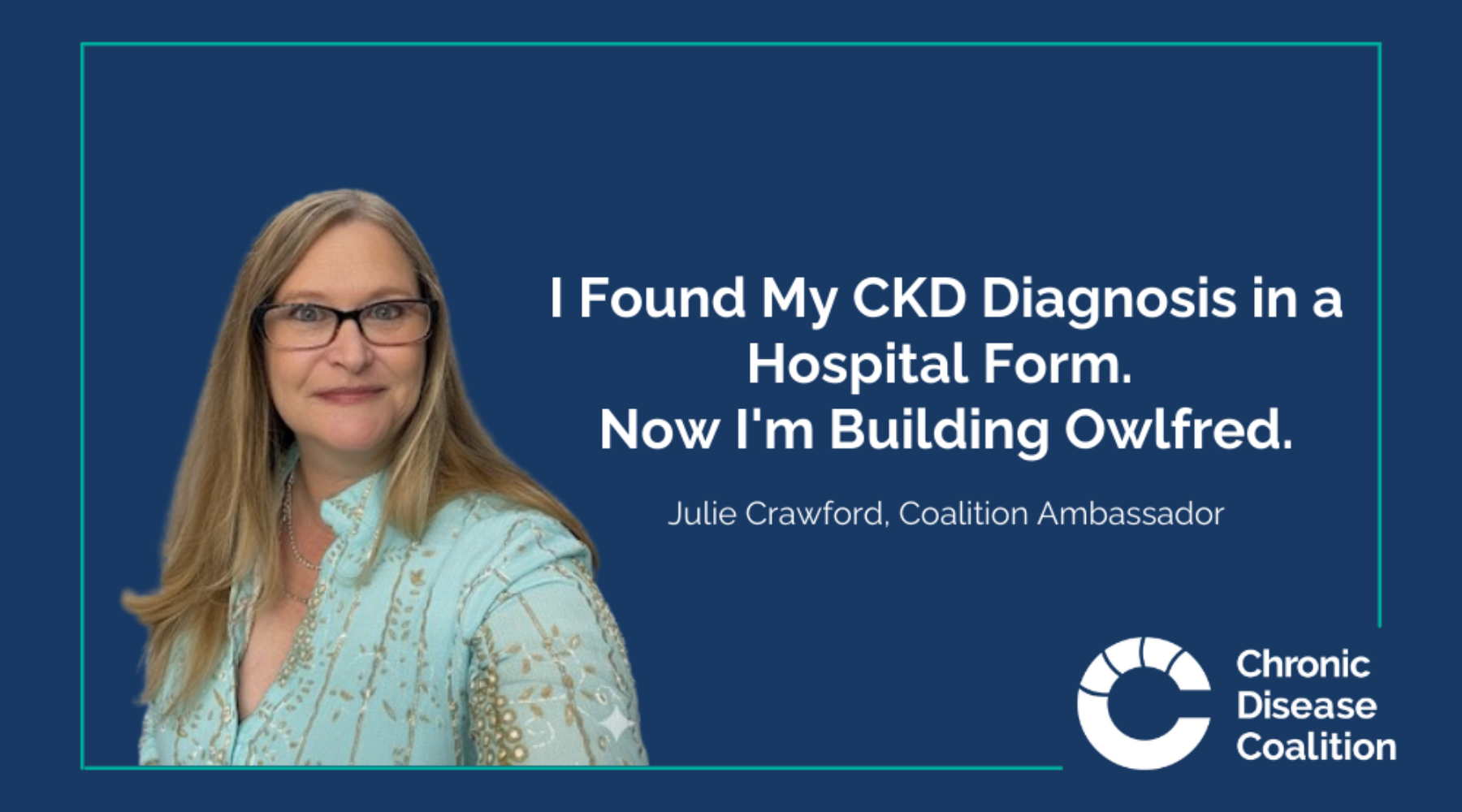
By Julie Crawford, Coalition Ambassador
March is National Kidney Month. This year’s focus is on taking charge of your health and the many factors that go into managing chronic kidney disease.
I did not set out to build a health tech company; I set out to survive in my own body. For years, I lived in the frustrating gap between "normal" labs and very real, systemic symptoms. My own diagnosis was a wake-up call to how broken the system is. I discovered I had chronic kidney disease (CKD) not through a doctor’s call, but by seeing the acronym “CKD” listed under diagnoses on a hospital admission intake form after a bout with a Postural Orthostatic Tachycardia Syndrome (POTS) flare. No one had ever mentioned it to me prior or discussed it during my hospital stay.
After my discharge, I spent four hours digging through five different patient portals to piece together my own history. I discovered that my kidney function had been declining since 2016, but because doctors were only looking at snapshots of labs they ordered, instead of the long-term trend, the pattern and eGFR fluctuations were never flagged. I followed up with my primary care provider the following week, showing her the data I gathered, and she agreed with the hospital’s diagnosis and then referred me to a nephrologist.
But kidney disease is not just my medical history; it is my family story. I lost my sister to kidney disease. She was a two-time transplant patient who lost her battle on March 7, 2021, one day before my birthday. Watching her journey taught me how reactive and disconnected care can be. When you love someone with CKD, you notice the patterns (the swelling, the dark circles under the eyes, and the fatigue) long before the lab work hits a red line. That is why I am building Owlfred.
What is Owlfred?
Owlfred is a pattern detection and tracking platform currently in development for people navigating complex, systemic, and “invisible” chronic illnesses like CKD, autoimmune issues, dysautonomia, and POTS. But anyone who is tired of managing their health across scattered portals and paper logs can benefit.
Owlfred solves the all too common data fragmentation problem. Usually, labs are in one place, symptoms are in your head, and medications are in another. Owlfred brings them into one longitudinal timeline. This empowers patients to walk into an appointment with organized, clinician-ready trends. Instead of trying to remember how they felt three months ago, they can show a clear connection between their labs, blood pressure, and daily symptoms.
Chronic illness often makes you feel invisible. My sister felt that, I feel that, and I know we are not alone in this fight. Owlfred exists so that patients feel seen and heard when they tell their story, not dismissed and discouraged.
Sometimes innovation doesn’t start in a lab; it starts at a hospital bedside.
Learn more about Julie and about Owlfred.