


You’ve been having trouble breathing. Your doctor runs tests, determines the cause, and writes a prescription. You leave the office feeling relieved — there’s a treatment, and your doctor knows what to do.
Then the insurance company calls.
They need to authorize the medication first. It could take several days. In the meantime, you wait.
This is prior authorization. And for people managing chronic disease, it isn’t a rare inconvenience. It’s a recurring feature of healthcare.
What the data show.
A January 2026 KFF survey found that prior authorization is now the single biggest non-cost barrier to healthcare for insured Americans. Among adults with chronic conditions, nearly four in ten identify prior authorization as their top obstacle — more than twice the share who cite any other issue, including understanding their bill, finding in-network providers, or getting timely appointments.
Roughly half of all insured adults say they have had a medication, treatment, or service either denied or delayed by their insurer in the past two years. Among those with chronic conditions, that figure rises to nearly six in ten.
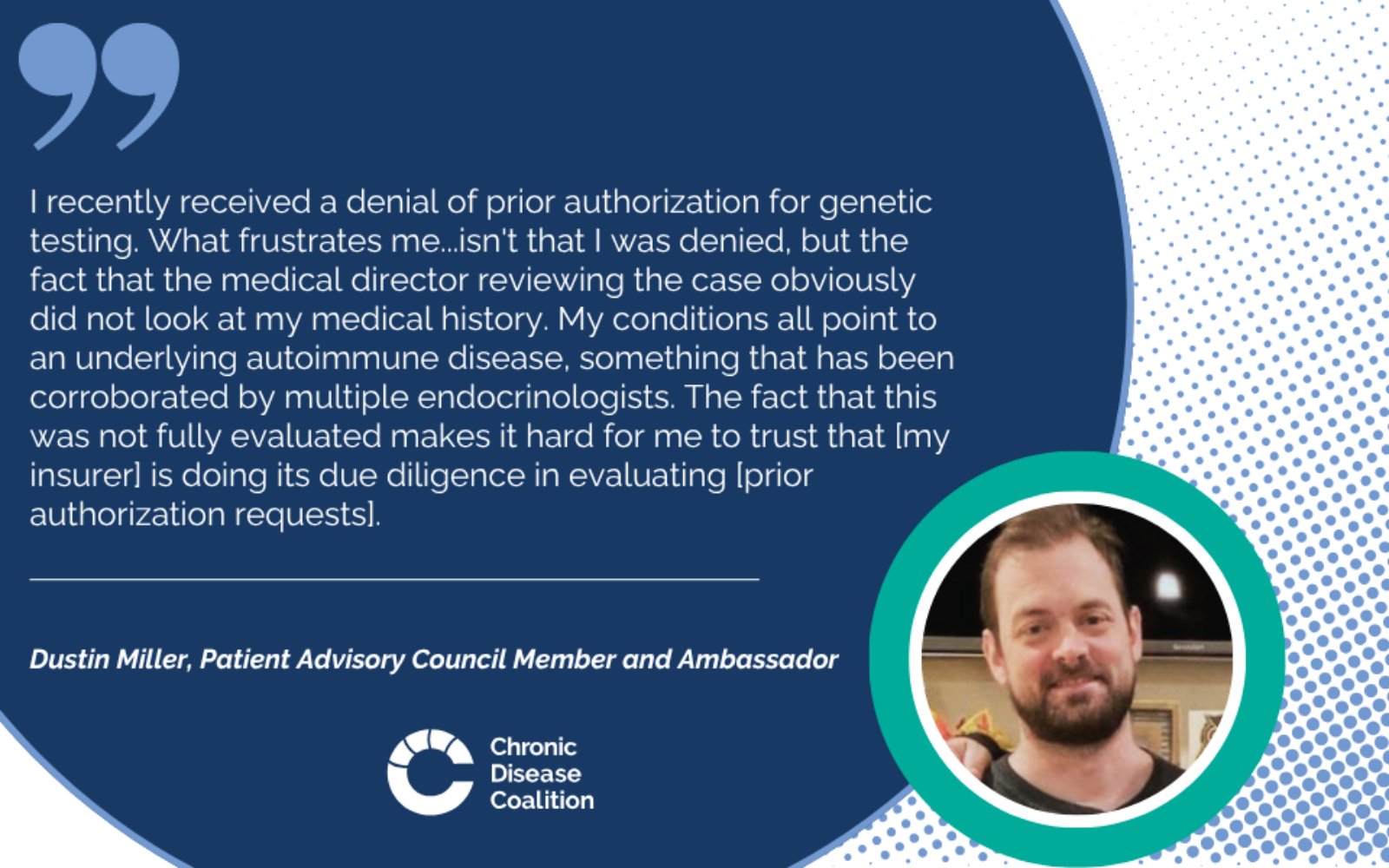
A 2025 systematic review published in the American Journal of Medicine synthesized 25 studies on the effects of prior authorization on patient outcomes. The findings were direct: prior authorization requirements are associated with disease worsening, preventable hospitalization, prolonged hospital stays, and lower rates of disease-free survival. In oncology, delays of even one to three weeks in starting guideline-based treatment correlate with worse outcomes. In behavioral health, prior authorization requirements have been linked to treatment interruptions and higher relapse rates.
The 2024 AMA physician survey found that nearly one in four physicians has seen a prior authorization delay or denial lead to a serious adverse event for a patient — including hospitalization, permanent impairment, or death.
The promises that weren't kept.
In 2018, a coalition of major insurers, physician groups, and hospital associations released a voluntary Consensus Statement committing to reform prior authorization practices. Nearly seven years later, physicians report little has changed. Only 16% of doctors working with major commercial plans say the industry’s self-imposed changes have reduced the number of prior authorization requests they complete each week. On average, physicians spend 13 hours per week — nearly two full working days — on prior authorization paperwork. Forty percent of practices employ staff whose entire job is completing prior authorization requests.
When voluntary reform doesn’t work, legislation becomes necessary. The bipartisan Improving Seniors’ Timely Access to Care Act would reform prior authorization in Medicare Advantage, requiring faster decisions, greater transparency, and better continuity of care when patients change plans. It has earned support from more than 248 House co-sponsors and 64 senators. It has not passed.
This is a rare issue that unites almost everyone.
Prior authorization reform enjoys broad support across political parties, insurance types, and demographics. Patients, physicians, hospitals, and employers have all called for change. The public agrees: roughly two-thirds of Americans describe insurance delays and denials as a major problem in the healthcare system, and only about one in ten say these issues are not a problem at all.
This week, we’re asking you to be part of moving this forward.
Send a letter to your state and federal elected officials and tell them how prior authorization has worked, or not worked, for you. And then ask them to:
- Pass the Improving Seniors’ Timely Access to Care Act or comparable federal legislation
- Require prior authorization decisions to be made by clinicians with relevant specialty expertise
- Support gold-carding programs that exempt physicians with strong prescribing records
- Ensure approved authorizations follow patients who change health plans
- Protect patients with chronic conditions from repeated re-authorization requirements for stable, long-term treatments
Do you have a prior authorization story you’d like to share with the Coalition? You can:
- Share your story about delays or denials you’ve faced navigating insurance requirements.
- Join the Coalition’s advocacy network to stay informed and engaged on policies that affect patients like you.
- Join us as Ambassador and get more actively involved in advocating for care.
Every day that prior authorization reform is delayed is another day that patients wait for care they have already been prescribed. When patients speak up, policymakers listen. Your story matters.
Learn more:
- Addressing Prior Authorization (one-page fact sheet)
- Prior Authorization and the Patient Experience
- Read an interview with Amish Dave, MD, a board-certified rheumatologist at Virginia Mason Medical Center in Seattle, Washington, who offers practical advice for patients and doctors.
- Watch The Spoonful, a quick video version of the interview with Dr. Dave.
- Read how state's like West Virginia are tackling prior authorization.